
A Note Before You Begin
IMPORTANT SAFETY NOTICE
These techniques are educational resources, not clinical interventions or therapeutic prescriptions. They are not a substitute for assessment, diagnosis, or treatment by a qualified mental health professional.
If you are experiencing significant distress, persistent low mood, anxiety that interferes with daily life, thoughts of self-harm or suicide, or any symptoms that concern you, please consult us Psypathology- +91 7898364691, or your nearest hospital as soon as possible.
Section 1: Breathing Techniques
The breath is the only function of the autonomic nervous system that you can consciously control. Every deliberate change in your breathing pattern sends a direct signal to the brain’s alarm centres, which is why breath-based techniques are among the fastest-acting self-help tools available.
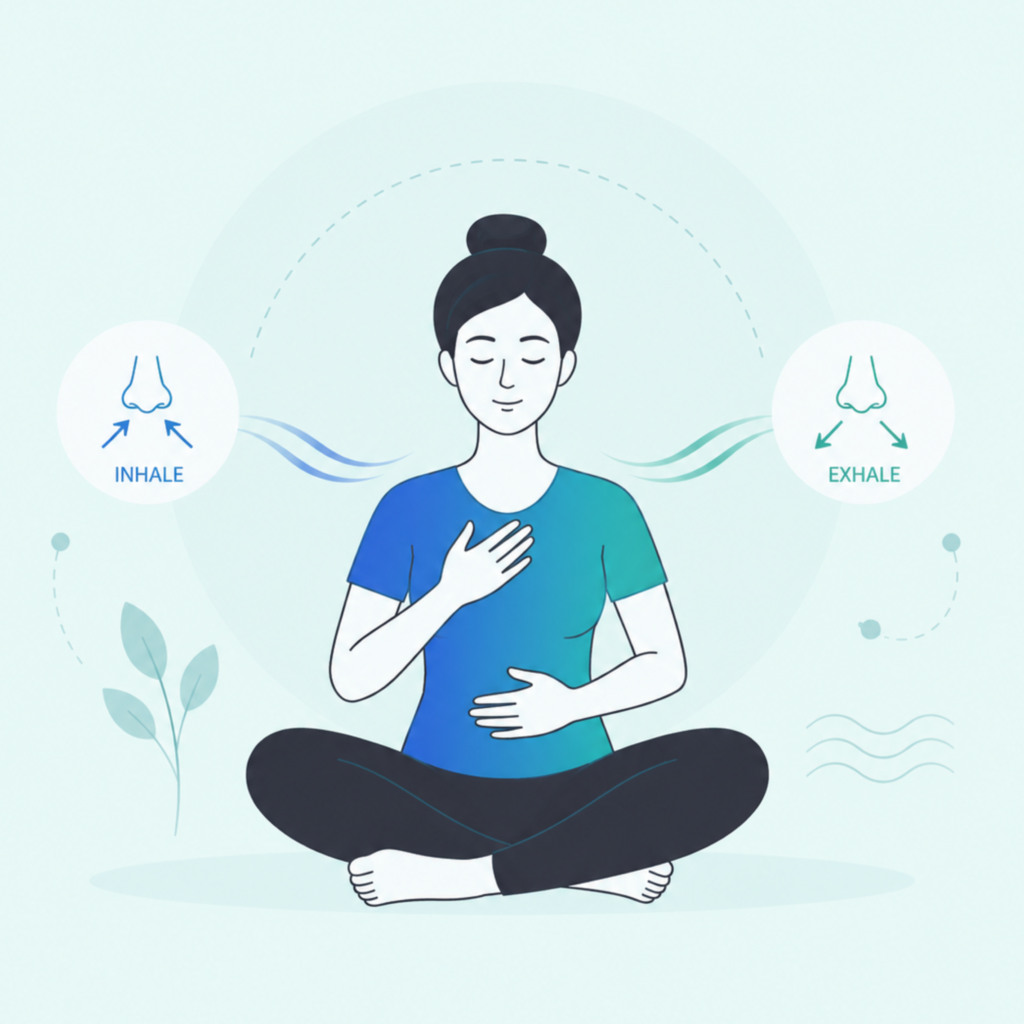
Technique 1.1
4-7-8 Breathing
Best used for:
acute anxiety, pre-sleep calming, sudden emotional overwhelm.
How it works
The extended exhale phase activates the parasympathetic nervous system, the branch responsible for rest and recovery. By making the exhale nearly twice as long as the inhale, this technique creates a shift in heart rate variability that signals safety to the brain.
Step-by-Step Instructions
01
Sit upright or lie flat. Place one hand on your chest and one on your abdomen.
02
Exhale completely through your mouth, releasing all air.
03
Close your mouth and inhale slowly through your nose for a count of 4.
04
Hold your breath comfortably for a count of 7. (Beginners: reduce to 5.)
05
Exhale fully through your mouth for a count of 8. You may produce a soft whooshing sound.
06
Repeat for 4 complete cycles. Then breathe normally.
Step-by-step Technique: the 5-4-3-2-1 Grounding Method
1. Notice 5 things you can see: Scan the space around you slowly. Name each object internally or aloud: a door, a plant, a shadow on the wall. This anchors you to the present moment.
2. Identify 4 things you can touch: Press your feet to the floor, feel the texture of your chair or clothing. Physical sensation signals safety to your nervous system.
3. Listen for 3 sounds: It may be distant traffic, an air conditioner, or your own breath. Name them without judging whether they are pleasant or unpleasant.
Find 2 things you can smell: Pick up any nearby scent, tea, paper, or fresh air from a window. Smell travels directly to the brain’s emotional centre, offering rapid calming.
Notice 1 thing you can taste: Sip water, or simply notice the natural taste in your mouth. Complete the cycle with a slow, deliberate breath.
Psypathology Clinical Note
Do not exceed 4 cycles per sitting when beginning. Lightheadedness is possible with breath-holding; always practise while seated or lying down. If you feel faint at any point, stop the technique and breathe normally. This technique is not recommended for individuals with respiratory conditions without prior medical clearance.
Section 1.2: Box Breathing (Equal Ratio)
Best used for: focus before high-pressure tasks, steadying emotions in conflict situations, and concentration in stressful environments.
Step-by-Step Instructions
01
Sit with your back straight and feet on the floor.
02
Exhale fully, releasing all air from your lungs.
03
Inhale through the nose for 4 counts.
04
Hold at the top for 4 counts.Exhale slowly through the mouth for 4 counts.
05
Hold at the bottom (lungs empty) for 4 counts.
06
This is one complete cycle. Practise 4–6 cycles.
Psypathology Clinical Note
Box breathing is widely used in high-performance and clinical settings. It is particularly effective when anxiety is mixed with cognitive pressure. It can be practised discreetly in any seated position at a desk, in a waiting room, or before a difficult conversation.
Section 2: Grounding Techniques
Grounding techniques work by redirecting attention away from distressing thoughts or memories and toward immediate, concrete sensory experience. They are especially useful when emotions feel overwhelming or when anxious thinking has become circular.
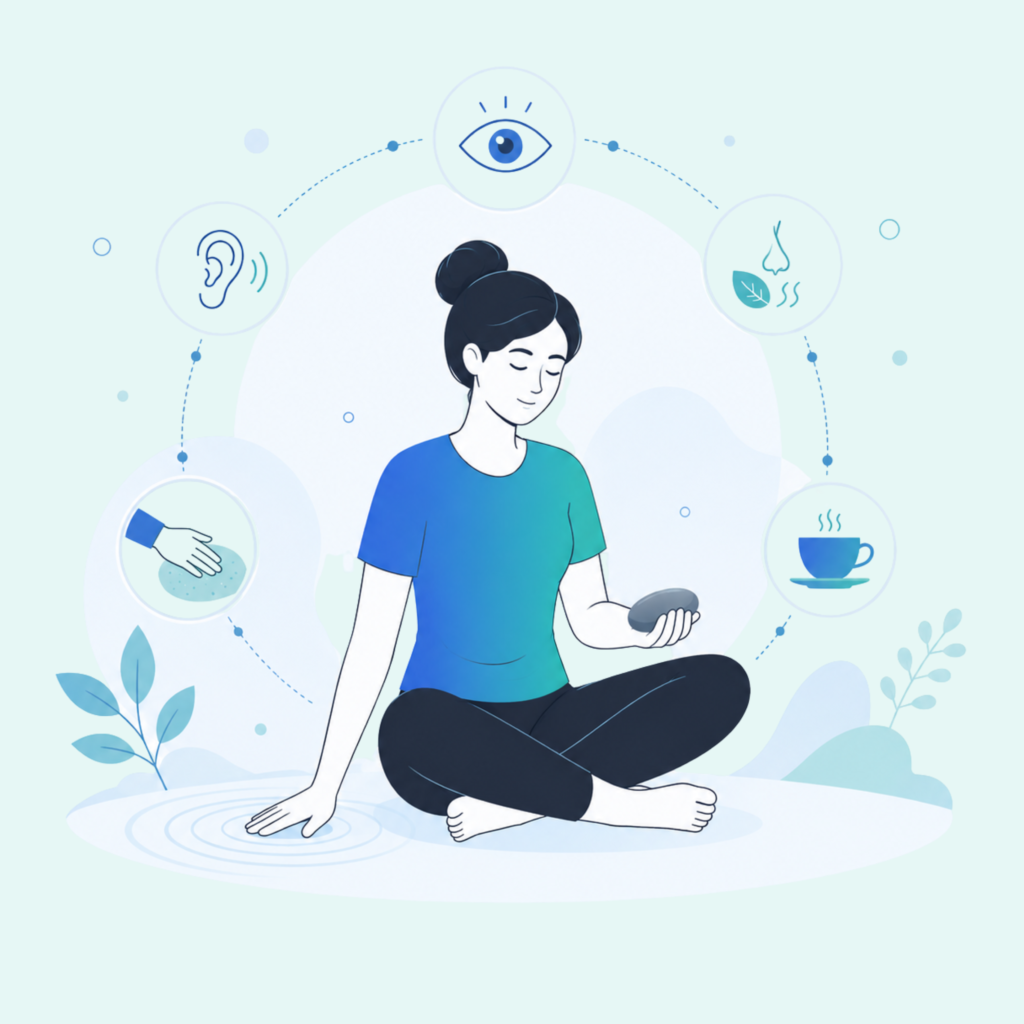
Technique 2.1,5-4-3-2-1 Sensory Grounding
Best used for: acute anxiety, dissociation, panic onset, intrusive thoughts, and emotional flooding.
Step-by-Step Instructions
01
Pause wherever you are and take one slow breath.Notice and silently name 5 things you can see. Be specific: not ‘a table’ but ‘a brown wooden table with a scratched corner.’
02
Notice and silently name 4 things you can physically feel or touch. Your feet on the floor, the texture of your clothing, the warmth of your hands.
03
Notice 3 sounds: near, middle, and far. Name each without judging whether it is pleasant.
04
Notice 2 things you can smell. If nothing is immediately present, recall a familiar scent.
05
Notice 1 thing you can taste. A sip of water, or simply the natural taste in your mouth.
06
Take one complete breath and return to your activity.
Psypathology Clinical Note
This technique works best when practised in calm moments, so it becomes automatic in times of distress. For children or adolescents, the numbers can be adjusted: 3-2-1 is sufficient for younger users. Not suitable as a standalone treatment for severe dissociative episodes; Contact to Contact to Psypathology +917898364691
Technique 2.2, Physical Anchor Grounding
Best used for: moments when thought-based techniques feel inaccessible or when physical agitation is high.
Step-by-step Instructions
01
Press both feet firmly and flatly onto the floor. Notice the full contact surface.
02
Press your back against the chair or wall behind you. Feel where your body makes contact.
03
Hold a small, firm object in your hand,a stone, a key, a pen. Squeeze it gently and notice its weight, temperature, and texture.
04
Say aloud: ‘I am in [location]. The time is [time]. I am physically safe right now.’
05
Repeat the statement twice more, slowly. Notice whether the quality of your breath has shifted.
Section 3: Progressive Muscle Relaxation (PMR)
Progressive Muscle Relaxation teaches the body to distinguish between tension and ease, a distinction that years of chronic stress can erode. Regular practice builds a conditioned relaxation reflex that becomes accessible even in demanding situations.
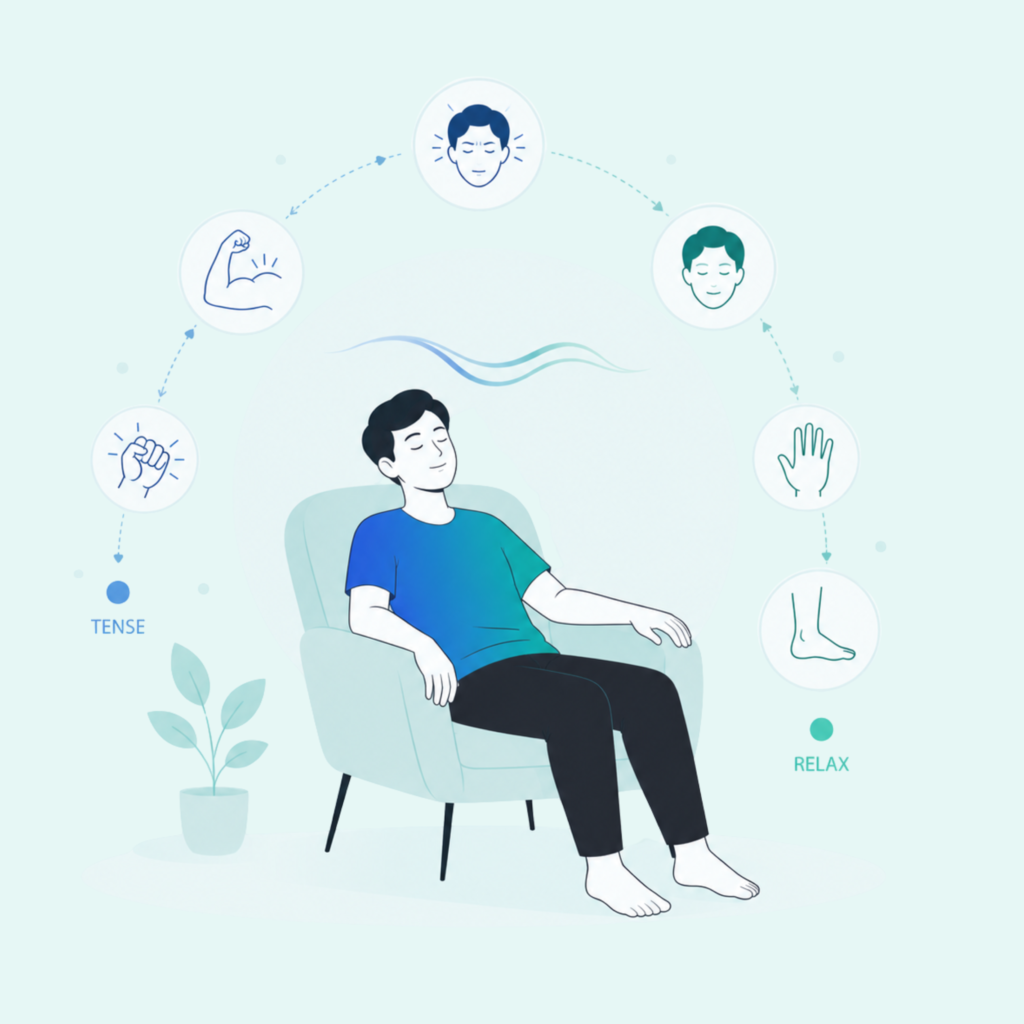
Technique 3.1, Full-Body PMR Sequence
Duration: 15–20 minutes. Best used for: chronic muscle tension, generalised anxiety, sleep preparation, stress recovery.
Preparation
Find a quiet space. Lie on a mat or sit in a supportive chair.
Loosen tight clothing, especially around the neck, waist, and feet.
Close your eyes gently. Take three slow breaths before beginning.
Preparation
1.Find a quiet space. Lie on a mat or sit in a supportive chair.
2. Loosen tight clothing, especially around the neck, waist, and feet.
3. Close your eyes gently. Take three slow breaths before beginning.
The sequence works upward from feet to face
1. For each muscle group: tense firmly (but without strain) for 5 seconds. Release fully. Rest for 10 seconds and notice the contrast between tension and release.
2. Feet and toes: curl tightly downward
3. Calves: pull toes upward toward shins
4. Thighs: press knees together or squeeze muscles firmly
5. Abdomen: draw navel gently inward
6. Hands: make tight fists
7. Forearms: bend wrists back toward forearms
8. Shoulders: raise them toward your ears
9. Neck: Press the back of your head gently against the surface behind you
10. Face: screw up your eyes, nose, and mouth tightly
Psypathology Clinical Note
After completing the full sequence, spend 2–3 minutes breathing naturally and scanning the body. If any area still holds residual tension, repeat the tense-release cycle once more for that region only. PMR is contraindicated for individuals with acute musculoskeletal injuries; consult a doctor first.
Consistent practice over two weeks produces reliable relaxation responses.
Section 4: Cognitive Self-Help Techniques
Cognitive techniques work with the relationship between thoughts and emotions. A recurring finding across decades of psychological research is that it is not events themselves, but our interpretation of events, that drives emotional responses. Learning to examine and reframe those interpretations is one of the most durable skills in self-directed mental health.

Technique 4.1: Thought Record (Basic)
Best used for: recurring negative thoughts, excessive worry, and mood fluctuations linked to specific situations.
The five-column thought record
Column 1: Situation: Describe the event factually. What happened? When? Who was present?
Column 2: Automatic Thought: What went through your mind immediately? Write the exact words.
Column 3: Emotion: Name the emotion and rate its intensity from 0–100.
Column 4: Evidence: What evidence supports this thought? What contradicts it?
Column 5: Balanced Thought: Based on all the evidence, what is a more complete and realistic way to view this situation? Re-rate the emotion.
Best used for: recurring negative thoughts, excessive worry, and mood fluctuations linked to specific situations.
Psypathology Clinical Note
Thought records are most effective when completed within a few hours of the triggering situation. Avoid using thought records during an acute emotional crisis; grounding first, then use the record when calmer. This technique forms the basis of formal CBT and is best learned alongside professional guidance for complex presentations.
Technique 4.2, Cognitive Defusion (ACT-Based)
Best used for: intrusive thoughts, rumination, self-critical thinking that feels ‘sticky’ or impossible to shake.
Cognitive defusion does not challenge the content of a thought; it changes your relationship to the thought. The goal is to observe thoughts as passing mental events rather than facts about reality.
Step-by-step Instructions
01
When a difficult thought arises, pause before reacting to it.
02
Instead of ‘I am a failure,’ restate it as: ‘I am having the thought that I am a failure.’
03
Then: ‘I notice I am having the thought that I am a failure.’
04
Imagine the thought as a leaf floating down a stream, or a cloud drifting across the sky. You are the sky,you contain the weather, but you are not the weather.
05
Return attention to what you were doing without needing to resolve or argue with the thought.
Section 5: Meditation Practices
Meditation is the practice of training attention. Unlike common misconceptions, the goal of meditation is not to empty the mind; it is to observe the mind’s activity without being swept away by it. Even a few minutes of daily practice produces measurable neurological changes over time.
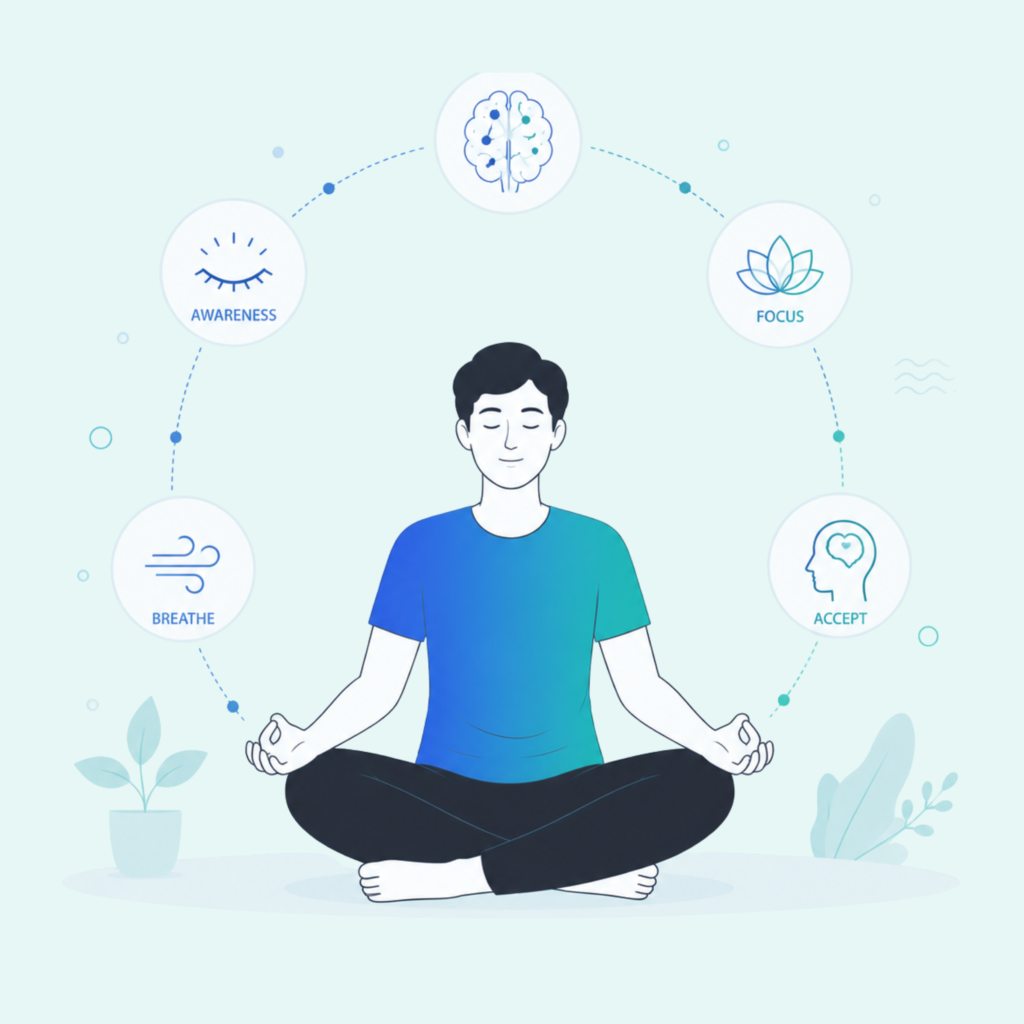
Technique 5.1, Breath-Anchor Meditation
Duration: 5–20 minutes. Best used for: establishing a daily meditation habit, reducing background anxiety, and building attentional capacity.
Step-by-step Instructions
01
Sit comfortably – on a chair, cushion, or the floor. Back gently upright, hands resting in the lap.Set a gentle timer. Begin with 5 minutes. Increase by 2 minutes each week.
02
Close your eyes, or lower your gaze softly toward the floor.
03
Bring attention to the physical sensation of breathing: the coolness of air entering the nostrils, the brief pause between breaths, the fall of the chest on the exhale.
04
When the mind wanders (it will, repeatedly – this is not failure), simply notice: ‘thinking.’ Return attention gently to the breath.
05
The act of noticing distraction and returning attention is meditation. Each return is a repetition of the practice, like a bicep curl for the mind.
06
When the timer sounds, sit quietly for 30 seconds before returning to activity.
Psypathology Clinical Note
Meditation is not appropriate as a primary intervention for severe depression, active psychosis, or acute trauma without professional guidance. Some individuals find that silent meditation temporarily increases difficult emotions. if this happens consistently, please contact Psypathology +917898364691. Meditate before checking your phone in the morning. This single habit shift significantly increases consistency.
Section 6: Mindfulness Practices
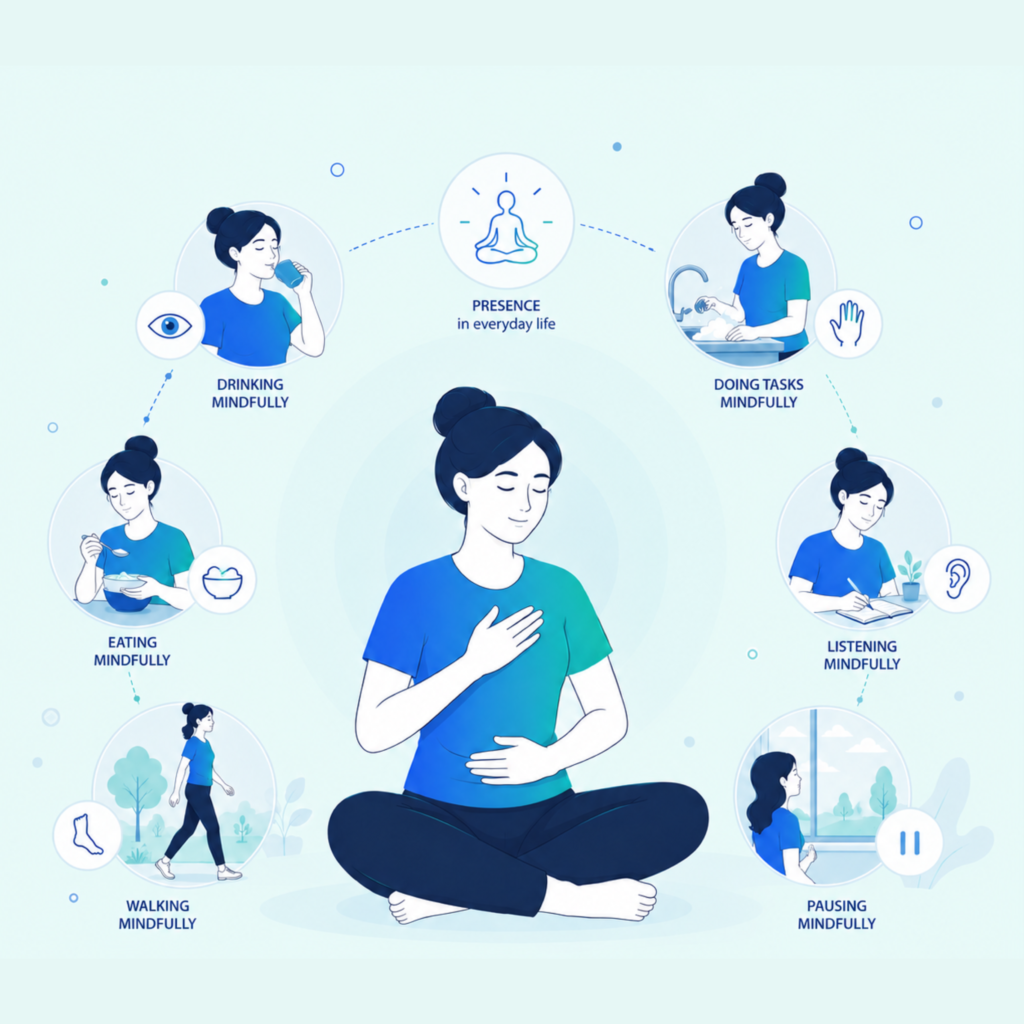
Mindfulness is not a separate activity set apart from daily life; it is a quality of attention that can be brought to any activity. The practices below demonstrate how ordinary tasks become opportunities for present-moment awareness.
Best used for: emotional eating patterns, poor appetite awareness, and eating to avoid difficult feelings.
Step-by-Step Instructions
01
Before the first bite, pause for 10 seconds. Notice the colour, texture, and aroma of the food.
02
Eat without screens, work, or multitasking during the meal.
03
Take small bites. Chew slowly and notice how the flavour changes across several chews.
04
Halfway through, put down utensils for 30 seconds. Notice your hunger level: are you still eating from hunger, or from habit?
05
At the end of the meal, take one breath before standing. Acknowledge the nourishment received.
Technique 6.2 The Mindful Minute
Best used for: breaking the cycle of rumination during a busy day, resetting attention between tasks.
Intuitive User Interface
Seamless Integration
Advanced Automation
Customizable Workflows
Step-by-Step Instructions
01
Set a one-minute timer.
02
For 20 seconds, notice 3 things you can see in your immediate environment.
03
For 20 seconds, notice the physical sensations in your body right now: tension, temperature, posture.
04
For 20 seconds: take 3 slow, deliberate breaths without changing anything else.
05
Return to your task. Notice whether the quality of your attention has shifted.
Psypathology Clinical Note
Choose one daily activity: morning tea, the first five minutes of your commute, or brushing your teeth and commit to doing it mindfully for 21 consecutive days. Single-habit anchoring is far more effective than attempting mindfulness across multiple contexts simultaneously.
Technique 7. Sleep Hygiene
Poor sleep is one of the most common and most reversible contributors to anxiety, mood disturbance, and reduced cognitive performance. Sleep hygiene refers to the set of conditions and habits that support consistent, restorative rest.
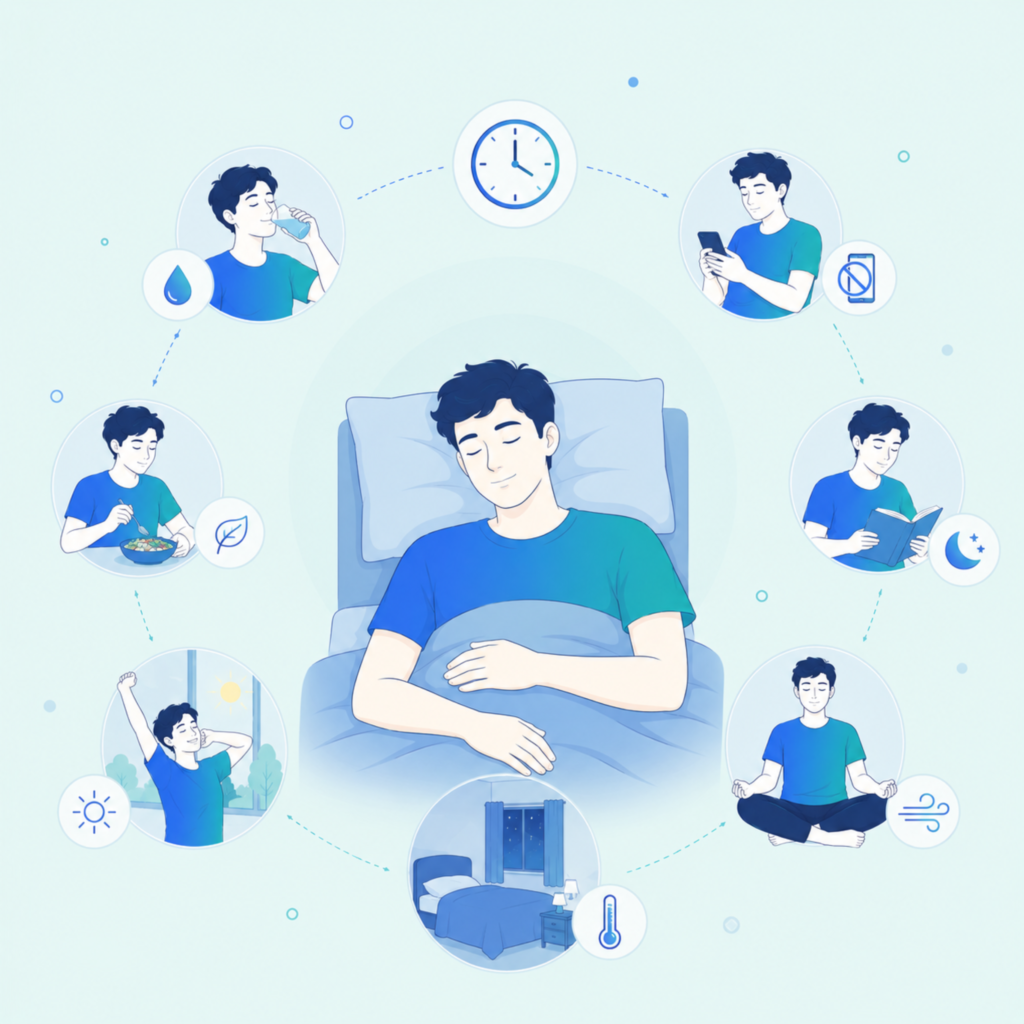
Set a consistent sleep and wake time, including weekends. Even a 90-minute weekend shift can cause ‘social jet lag’ that disrupts sleep the following week.Begin a wind-down period 60 minutes before bed. Dim lights, reduce screen brightness, and shift to calm activities, such as reading, light stretching, or quiet conversation.
Remove screens from the bedroom. Blue-spectrum light suppresses melatonin production for 2–3 hours.Keep the room cool (18–21°C), dark, and quiet. The body’s core temperature drops during sleep onset a cool room supports this process.
If sleep does not come within 20 minutes, get up. Move to another room, do something calm, and return only when genuinely drowsy. Lying awake training anxiety about sleeplessness worsens insomnia.
Write a brief ‘tomorrow list’ before bed. Externalising unfinished thoughts on paper reduces their tendency to resurface at night.
Pick one technique from this library. Practise it for a week. See what changes.
And if at any point you find that what you are carrying is too much for self-help to hold, please reach out to us, to a doctor, to anyone qualified. That is not a step away from this practice. It is part of it.
PLEASE READ: WHEN TO SEEK PROFESSIONAL HELP
Please consult a US PSYPATHOLOGY with walk-in/in-person or any nearest medical facility if you are experiencing any of the following:
• Persistent low mood, hopelessness, or inability to experience pleasure (lasting more than two weeks)
• Anxiety that significantly interferes with your daily functioning, relationships, or work
• Intrusive, distressing thoughts or memories you cannot control
• Hearing, seeing, or believing things that others around you do not
• Using substances, food restriction, or self-harm as the primary way of managing emotional pain
• Thoughts of suicide or of harming yourself or others
• Symptoms that you have been managing for a long time, and which have not improved
Seeking professional support is not a sign that you have failed at self-help. It is the most effective and courageous thing you can do for your mental health.
India Crisis and Mental Health Helplines:
1. iCall (TISS Mumbai): 9152987821 — Weekdays, 8 AM–10 PM
2. Vandrevala Foundation: 1860-2662-345 | 1800-2333-330 (24/7, toll-free)
3. NIMHANS (Bengaluru): 080-46110007
4. Snehi (Delhi): 044-24640050